
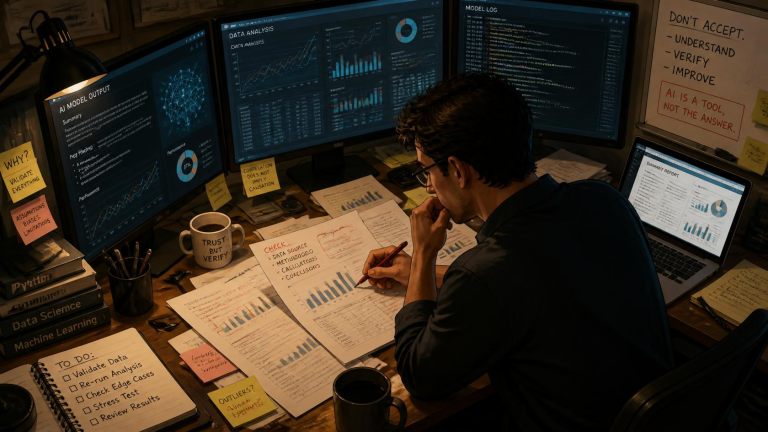
While executives celebrate “doubled productivity” on shiny dashboards, front-line employees are burning out under a new, uncredited job title: AI Babysitter.
If your HR department isn’t leveraging AI by 2027, your tech stack belongs in a museum next to the fax machine. Recent Gartner data from early 2026 confirms that at top companies, 97% of employees now use AI in their core functions to handle admin, sort CVs, automate payroll, and track spreadsheets.
But this rapid tech explosion has created a massive corporate paradox: Can you automate the workplace without turning your company culture into a hollow, pre-written script? With AI recruitment frequently making headlines for systemic bias, leadership can no longer pretend algorithms are objective truth-tellers.
- Algorithmic Bias: October 2026 research from Princeton and the University of Chicago reveals that AI tools can invent entirely new, baseless social biases from random experiential feedback over time, actively segregating candidates even when trained on neutral data.
- Self-Preferencing: Recent findings show recruitment algorithms exhibit a behavior making candidates who use the same AI model as the recruiter up to 60% more likely to be shortlisted.
Executive expectations are sky-high, with SHRM data showing 92% of CHROs pushing for deeper operational integration. Yet leadership is making a classic rookie mistake: automating processes first and thinking about their people second. The real win isn’t replacing human interaction; it’s using AI to eliminate mundane administrative slop so managers can actually get up from their desks and talk to their staff.
The Executive Blindspot: The Babysitting Burden
Management routinely expects flawless results from algorithms, conveniently forgetting that generative AI frequently produces “workslop”, content that looks highly polished but is factually hollow. This leaves employees doing frantic, uncredited quality control under tighter deadlines. That magical “one-click report” actually requires a three-hour human rescue mission to be usable.
A global study by the University of Melbourne and KPMG highlights this reality:
- The Error Epidemic: 56% of employees have made workplace mistakes because they trusted uncorrected, confidently incorrect AI outputs.
- The Rushed Reality: 66% of workers routinely pass along unverified AI data just to keep up with hyper-inflated, executive-driven performance targets.
This drives a massive recognition deficit. The Perkbox Perkonomics Report found a massive disconnect between management and staff:
- 69% of employers think AI creates a better workplace.
- Only 38% of employees agree.
- 38% of workers say AI actively robs them of a sense of personal accomplishment.
When a project succeeds, leadership praises the tool’s efficiency. When it fails, the human gets blamed for not fixing the machine’s mistakes. It is a brilliant setup if your goal is destroying morale.
The Internal Friction Audit: 5 Points to Check Your Workplace
To know if your team is quietly polishing their CVs because of your tech stack, HR managers must audit these five frustration levels using the latest 2026 benchmarks immediately:
- The “Workslop” Babysitting Rate: Audit how much uncredited time your team spends fixing broken machine drafts. If they are rewriting 80% of an “automated” report, your software investment is just an expensive typewriter.
- The Deadline Pressure Valve: Check if your turnaround expectations are forcing staff to play Russian roulette with corporate compliance just to meet aggressive targets.
- The Recognition Deficit Index: Look at your recent wins. Did leadership praise the software vendor or the human who actually steered the ship away from a data disaster?
- The Autonomy Deficit: Audit whether your high-skill roles have devolved into low-level data entry and cleaning up after an algorithm.
- The Training Gap Friction Score: Fresh data from Oyster’s 2026 Global AI Talent Report reveals that 95% of HR leaders acknowledge employees use AI tools daily for tasks never written into their official job descriptions, while 62% of companies haven’t changed job titles or compensation to reflect this extra work.
The Fix: Practical HR Interventions
If HR wants to salvage company culture, they need to stop pitching AI as a magic wand and start managing it as a tool. Forward-thinking companies are changing the playbook:
- Reward the Edit, Not Just the Output: Rewrite your performance metrics. If an employee spends two hours fact-checking a broken AI report to save a client relationship, reward that critical thinking. Stop measuring success purely by raw volume—otherwise, you are just incentivizing faster mistakes.
- Kill the “Coordination Tax”: Use automation to eliminate the repetitive back-and-forth of scheduling and data entry. Take that saved time and force managers out from behind their screens into real, face-to-face conversations.
- Flag Burnout Before It Happens: Don’t wait for annual exit surveys. Use smart sentiment analysis to spot communication drops or spikes in overtime. Let tech flag the smoke, but send a human to put out the fire.
The Bottom Line
The line between technology and human execution is completely gone. An IWG study via HR Online shows that 82% of executives believe AI is fast-tracking younger Gen Z talent into management roles faster than ever. However, true leadership skills cannot be downloaded from a prompt window.
A company that no longer sees its employees as an asset is in big trouble. The companies winning the talent war aren’t the ones with the flashiest tech stacks; they are the ones using AI to give their people the breathing room to be human.

This article was written and published by Liesel Cloete.
The Award-Winning CV Writer Behind SA CV Writing Studio
“With an extensive HR/Payroll background, I transitioned from the corporate world and founded SA CV Writing in 2014 to empower professionals in their career journeys. My clients report back on securing interviews with local and international firms.”